
Tap Repair by a Red Seal Plumber
Main Drain Mechanical is a licensed plumbing and mechanical company serving homeowners, strata buildings, and general contractors across the Lower Mainland; handling everything from urgent service calls to planned fixture work. Tap repair services sit squarely in that core scope: it’s one of the more common calls the team handles, and with a Red Seal plumber on every job, the diagnosis is right before anything gets touched. If a dripping kitchen tap or a stiff, corroded fitting has been on your list longer than it should be, that’s exactly the kind of thing this crew is set up to take care of.
When a Simple Tap Becomes a Bigger Problem Than It Looks
A dripping tap rarely announces itself in daylight, it’s the sound you hear at night when the house is quiet, the thing you tighten and it holds for a day before starting again. By the time you’re searching for an answer, you’ve likely already tried the obvious fix and watched it fail. The real frustration isn’t the drip; it’s not knowing whether it’s a worn washer or something further into the wall. Swap the wrong part and the leak just moves somewhere else. Wait too long and water finds the cabinet floor, the subfloor, the unit below yours. A leaking faucet repair delayed only gets more expensive, the sooner you fix a leaking tap or repair water tap issues, the less it costs to put right.
Our Tap Repair Services!
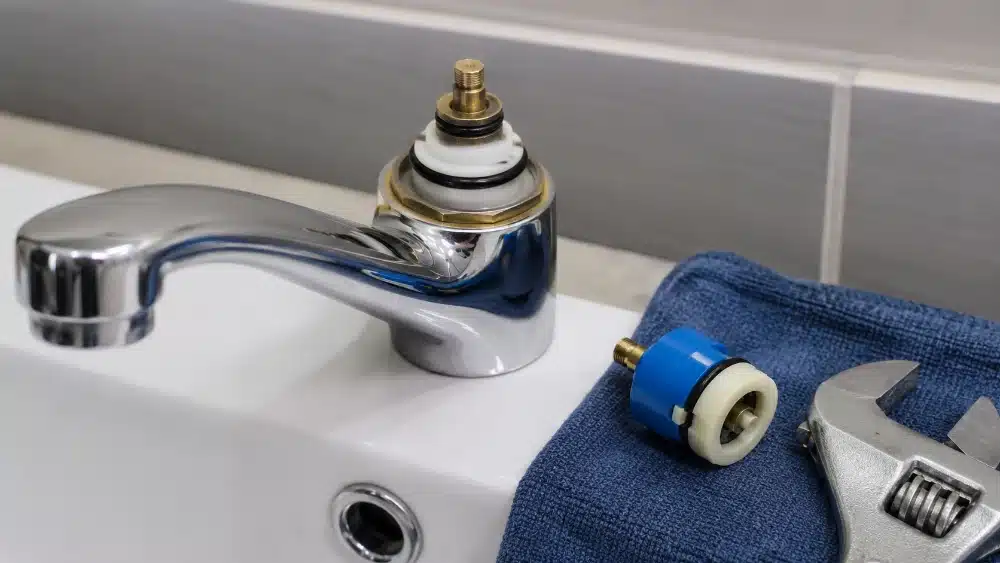
Tap repair means disassembling the fixture, identifying exactly what’s failing, a worn cartridge, a deteriorated O-ring, a faulty ceramic disc, and replacing the right part with the right material so the fix holds. Whether it’s tap cartridge repair or tap valve repair, Main Drain Mechanical’s Red Seal-certified plumbers have handled enough kitchen tap repair and bathroom tap repair calls to know that the visible drip on a faucet is rarely the whole story, and correcting it properly the first time is what keeps you off the phone scheduling a follow-up. Every job leaves the workspace clean and carries a 1-year workmanship warranty.
How We Approach Tap Repair
Each job follows the same standard, assess the tap correctly, source the right components, and execute a repair that doesn’t need revisiting.
- We don’t trust a fix until we know what actually failed. A worn cartridge and a cracked seat can look identical from outside, replacing the wrong one just buys you a few weeks before the same drip is back.
- Generic parts on a branded tap are how a repair fails early. We match components to the specific fixture, not the nearest part on the shelf, because a mismatched seal rarely holds a proper seat for long.
- A tap maintenance is a chance to catch what’s coming next. Supply lines and shutoff valves get checked while everything’s already open, a corroded shutoff or a failing line found now is a lot cheaper than one found later.
- We don’t call it fixed until it’s held under real pressure. A drip that only shows up at full supply pressure won’t show up on a bench test, so that’s the condition we actually test under before anything gets closed up.
- If something’s bigger than the tap, we say so. Early signs of a plumbing leak behind the wall or a pressure issue that could stress the repair get flagged plainly, not left for you to discover later.
- The cabinet gets left the way we found it, every time. That’s not a courtesy, it’s part of what “done” actually means on a job like this.
Who We Serve?
How It Works: From Your First Call to a Warranted Job!
From the moment you reach out to the moment the water runs clean and quiet again, here is exactly what to expect, and no step should surprise you.
- You describe what the tap is doing; we listen before we diagnose. Tell us whether it’s dripping at the spout, weeping at the base, stiff to turn, or spraying off-angle, that description shapes what parts and tools arrive on the truck. The more specific you are, the less time we spend ruling things out on site.
- We isolate the tap and open it up. Once on site, we shut off the supply, remove the handle and cartridge or valve assembly, and look at what’s actually failing, not what typically fails. A worn cartridge looks different from a cracked valve seat, and getting that wrong means the tap drips again in three months.
- We show you what we found before anything gets replaced. You see the worn washer, the corroded seat, the stripped packing nut; whatever it is, and we explain in plain language what it’s doing and why replacing it (or the whole cartridge) is the right call versus a temporary patch. No parts get ordered or installed without your go-ahead.
- We complete the repair and pressure-test on the spot. The new cartridge, washers, O-rings, or valve seat is fitted, the supply is restored, and we run the tap through its full range; hot, cold, full flow, trickle, checking for any weep at the body, base, or supply connections before we reassemble the handle.
- We leave the space clean and walk you through what was done. Every fastener goes back, the under-sink cabinet gets wiped down, and we give you a plain-language summary of the repair so you know what was replaced and what the 1-year workmanship warranty covers if anything comes back.
What Changes When a Plumber Actually Fixes the Tap
Most tap problems don’t disappear on their own; they shift. Here’s the difference between a temporary patch and a repair that holds.
| Before | After |
|---|---|
| Handle tightened repeatedly but the drip returns within days | Worn internal components replaced so the tap seats properly and stays dry |
| Water pooling under the cabinet with no visible source | Leak point identified and sealed at the fitting, not just wiped down |
| Tap runs hot when turned to cold due to a crossed valve | Valves reseated and flow direction confirmed correct before the job is closed |
| Stiff or grinding handle that takes effort to operate | Cartridge or seat replaced so the handle turns smoothly with normal pressure |
| Slow drip wasting water and quietly adding to the monthly bill | Flow fully stopped, no drip, no residual seep between uses |
| Caller told “probably just the washer” without an inspection | Root cause confirmed on-site before any part is ordered or swapped |