
Licensed Gas Fitter Services for Strata Buildings, Renovations, and Homes
Main Drain Mechanical is a licensed plumbing and mechanical company and gas fitting contractor serving strata property managers, general contractors, and homeowners across the Lower Mainland. The company’s gas fitting services sit inside a broader mechanical trade practice built around one standard: the right credentials on every job, documented and backed by a 1-year workmanship warranty. Holding a Class B gas fitter certification alongside Red Seal plumber status means the crew handles gas line work, appliance connections, and pressure testing as a core competency, not as an occasional add-on.
When the Gas Line Looks Fine Until It Isn’t
You smell something faint near the range; maybe metallic, maybe nothing, hard to say. Or a contractor has roughed in a new gas line for the outdoor kitchen or a BBQ gas line installation and now the permit inspection is coming up and nobody’s sure the pressure test has actually been done. Or a strata building’s mechanical room has an aging appliance connection that passed the last inspection three years ago and hasn’t been looked at since. The instinct in each of these moments is to wait, look it up, or ask a handyman who’s comfortable enough with tools. Gas doesn’t reward that approach. A fitting that’s slightly out of spec, a flexible connector past its service life, or a line run without the right pressure test doesn’t announce itself before it becomes something serious.
What a Gas Fitter Actually Does on a Call Like Yours
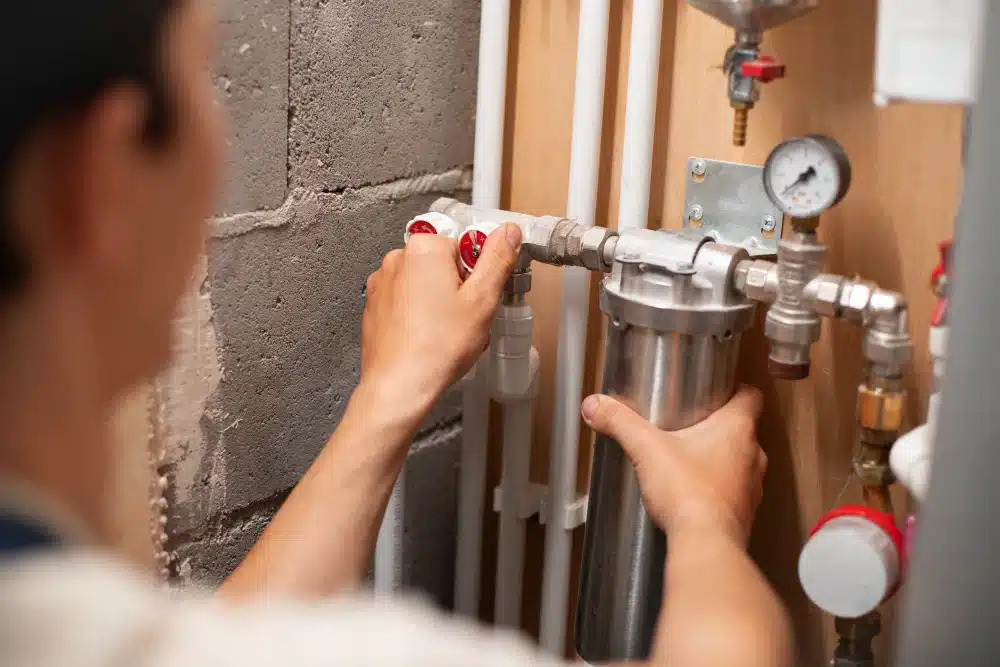
Gas fitting covers the licensed side of every natural gas line installation and propane line installation task a building or home requires, new line installations, appliance connections like a gas fireplace connection, pressure testing, flexible connector replacements, and the permit and inspection coordination that makes the work code-compliant and insurable. Main Drain Mechanical holds a Class B gas fitter certification and carries full liability insurance and WorkSafeBC coverage, which means the technician arriving on site is qualified for the job under BC code requirements, not approximating it. The outcome is straightforward: the gas system functions correctly, the paperwork reflects what was done, and nothing gets left in a state that causes a problem six months later.
How We Approach Each Gas Fitter Call
A pressure drop in an aging strata mechanical room and a new BBQ gas line on a renovation aren’t the same call, and they don’t get the same shortcuts.
- An existing line doesn’t get blamed on new work without proof. What the line or appliance was already doing gets confirmed before anything is touched, so a pre-existing issue in an aging connection doesn’t get misattributed to the job just performed.
- A line that holds at the appliance isn’t automatically a line that’s safe. Every completed run gets pressure tested to BC gas code compliance, because a leak at a buried fitting is more dangerous than one that shows itself immediately – passing at the visible point isn’t the standard.
- A connector’s age matters more than whether it looks fine. Flexible connectors past their service life get replaced on sight, particularly in strata mechanical room gas fitting contexts where equipment sits for decades between inspections.
- A permit doesn’t get treated as paperwork to catch up on later. Applications and gas permit inspection scheduling happen upfront, because a strata manager or contractor chasing a permit office mid-project is a delay this crew doesn’t create.
- The right material doesn’t get swapped for what’s on the truck. A fitting rated for indoor residential use behaves differently on an outdoor commercial line through Lower Mainland temperature swings, so application-specific materials are non-negotiable.
- A completed job without a written record isn’t actually finished. Documentation of what was installed, tested, and inspected gets left behind, because a strata council, property manager, or insurer needs something to reference, not a verbal assurance.
Our Process
What’s Included in a Gas Fitter Call
Here’s what’s covered from first contact to a completed, documented job, a sequence that’s different from a standard plumbing or HVAC call because of the permit, pressure test, and inspection requirements attached to anything involving a gas line.
- Scope confirmation before the crew arrives: appliance connection, pressure test, connector replacement, or new installation, and whether a permit application needs to go in ahead of the visit.
- A site assessment of the existing gas system, including connector age and valve condition for strata mechanical rooms, or supply line capacity for a renovation’s new appliance load.
- Installation or repair to BC code material and method requirements: no substitutions for what’s available that day.
- A pressure test, witnessed and recorded, confirming the completed run holds before it goes into service.
- Permit inspection coordination, where required, so the strata manager, property manager, or GC isn’t chasing the permit office mid-project.
- A job file with the inspection record, once the work is complete.
What Does a Plumber Cost in the Lower Mainland?
Gas fitter work in the Lower Mainland starts at a service call rate that covers arrival, diagnostic assessment, and minor repairs. Most straightforward appliance connections or flexible connector replacements fall in the range of a few hundred dollars for labour once materials are confirmed.
New gas line installations or permit-required work, including commercial gas fitting installation involving multiple runs, pressure testing, and inspection coordination are priced by scope and typically range from several hundred to several thousand dollars depending on linear footage, materials, permit fees, and site complexity.
The single biggest cost variable on a gas fitter call is whether a permit is required and how much existing infrastructure needs to be assessed or modified before the new work can go in.