
Red Seal Certified Sump Pump Installation
Main Drain Mechanical is a licensed mechanical contractor serving homeowners, strata property managers, and general contractors across the Lower Mainland. As a sump pump installation company, this is where a Red Seal plumber’s understanding of drainage and water table behaviour actually changes the outcome. Whether it’s residential sump pump installation for a basement or commercial sump pump installation for a strata mechanical room, this crew handles it.
The Basement That Looked Fine Until It Wasn’t
Water doesn’t always announce itself. It seeps in slowly through a foundation crack, pools quietly in a corner, or builds up under the slab over days of steady rain, and by the time someone notices, the drywall is already wicking. Most homeowners and strata managers don’t think about groundwater management until a finished basement is ruined or a mechanical room has six inches standing in it. And once that happens, the instinct is to mop it up and move on, which works right up until the next storm, or the one after that, because nothing about the underlying drainage situation has changed.
Sump Pump Installation Services
Sump pump installation means placing the right pump in the right location, setting the correct float height, sizing the discharge line properly, and confirming the system activates and drains the way it needs to, every element of that setup affects whether the pump holds up under pressure or fails the first time a heavy storm hits. As a licensed sump pump installer, Main Drain Mechanical’s Red Seal-certified crew has handled these installs across a wide range of Lower Mainland basements and mechanical rooms, carrying full liability insurance and WorkSafeBC coverage on every job, and every sump pump installation we complete is backed by our 1-year workmanship warranty. Get it sized and set up correctly once, and you stop thinking about what’s happening under your floor.
How Main Drain Mechanical Approaches Sump Pump Installation
Every install starts with an honest look at the space; not a quick drop-in and out.
- We assess the pit location and water entry points first, so the pump gets positioned where it can actually intercept groundwater rather than sitting in a spot that misses the main flow path.
- We size the pump to match the actual drainage load, because an undersized unit runs constantly and burns out early, while an oversized one short-cycles and wears the motor faster than it should.
- We set the float switch at the right activation height, so the pump triggers early enough to manage rising water and shuts off cleanly, preventing both overflow and dry-running.
- We route and seal the discharge line properly, with a check valve to stop water cycling back into the pit, directing water far enough from the foundation that it doesn’t return, one of the most common oversights in rushed installs.
- We test the full system before we leave, running a live check to confirm the float activates, the pump moves water at the expected rate, and the discharge clears the way it’s supposed to.
- We walk you through what to watch for after installation, so you know the normal operating sounds, when to call, and whether a battery backup makes sense for your situation given Lower Mainland storm patterns.
Our Approach
How We’ll Deliver the Service!
Before any work starts, you want a clear picture of two things: what actually happens, and what it costs. Here’s both.
- Site assessment and pump sizing: Before anything gets ordered, a technician walks the space, basement floor level, foundation wall condition, existing drainage path if one’s already there, and measures the actual water infiltration volume the pump needs to handle. This step determines the right horsepower and tank size for your specific situation; undersizing a pump here is how a replacement job starts three years from now.
- Pit excavation or prep: If no sump pit exists, one gets cut into the concrete floor at the lowest collection point; typically 18–24 inches deep and wide enough to house the liner properly. If a pit is already in place, the crew inspects it for cracks or undersized dimensions before the liner goes in. This is where most DIY installs go wrong: a pit that’s too shallow or mispositioned defeats the pump regardless of brand.
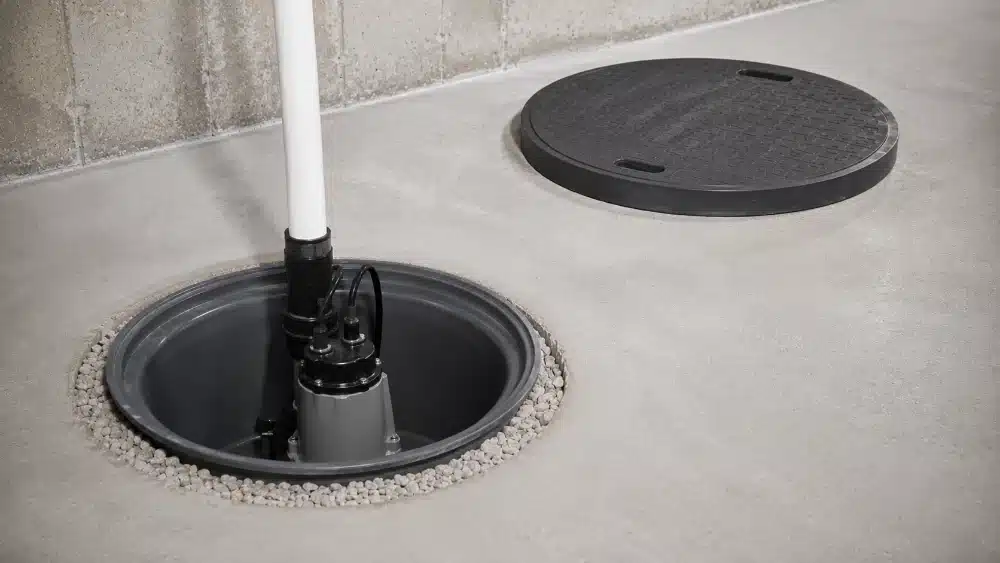
- Liner installation and gravel bed: The perforated liner seats into a compacted gravel bed that lets groundwater migrate in from below rather than pooling around the casing. The lid is fitted and sealed to reduce humidity and keep debris out of the mechanism, a detail that directly affects how long the pump runs reliably.
- Pump placement, wiring, and discharge line: The pump drops in, the float switch is set to the right activation depth, and the discharge line is run to a proper exterior exit point away from the foundation, not just to the nearest drain.
- Test cycle and walk-through: Water is introduced into the pit to trigger the float and confirm the pump activates, moves water out, and shuts off cleanly. You see it work before the crew leaves. Any adjustments to float height or discharge pressure happen on the spot, and the 1-year workmanship warranty is confirmed in writing.
Before a Sump Pump Installation, After One
The difference a properly installed unit makes isn’t subtle, it shows up every time it rains.
| Situation | Before Installation | After Installation |
|---|---|---|
| Heavy rainfall | Groundwater accumulates under the slab with nowhere to go | Water is actively collected at the pit and discharged away from the foundation |
| Finished basement | Damp walls and wicking drywall signal a problem already in progress | The pit intercepts water before it reaches the floor or framing |
| Mechanical room | Standing water creates a corrosion risk for equipment sitting at floor level | Equipment sits on a dry floor with the pump cycling automatically during rain events |
| Strata building common area | Property manager fields tenant complaints after every major storm | Drainage operates on its own; complaints stop because the problem stops |
| Pump sizing | Undersized or improperly located unit struggles to keep up in a high-water-table area | Unit is sized to the actual inflow rate and pit depth for that specific property |
| Workmanship | No warranty, if something fails early, the repair cost falls on the owner | 1-year workmanship warranty covers the installation if anything doesn’t hold |