
Pool Work, Done by a Licensed Plumber
Pool plumbing repair sits inside a broader specialty at Main Drain Mechanical; pressurized water systems and below-grade pipe work, serving homeowners, strata property managers, and general contractors across the Lower Mainland. As a pool plumbing repair company, we handle residential and commercial jobs alike, a single backyard pool or a shared amenity pool at a strata building, same standard either way. The team holds Red Seal certification, full liability insurance, and WorkSafeBC coverage, which matters when the work involves buried lines and systems that run continuously. If your pool is losing pressure or leaking somewhere you can’t see, this is the crew to call.
When the Pool Stops Circulating and You Can’t See Why
You notice it gradually, pressure dropping at the returns, a pump that cycles on then cuts out, water sitting cloudier than it should. Nothing dramatic, nothing obvious. Pool plumbing failures rarely announce themselves cleanly: the lines are buried under concrete or decking, the fittings sit inside equipment pads, and the chemical environment quietly degrades joints and seals long before a visible crack appears. By the time there’s a wet spot near the equipment or the pump loses prime entirely, a pool plumbing leak has usually been building for a while. Calling a general plumber who hasn’t worked with pressurized pool systems often means a second call when the first fix doesn’t hold.
Pool Plumbing Repair Services
Pool plumbing repair means diagnosing and fixing the pressurized circulation system beneath your deck; the supply lines, pump connections, filter fittings, and valves that keep water moving correctly. It’s work at the intersection of pressurized pipe work, buried lines, and chemically aggressive water, which is why a Red Seal certified plumber matters, a guess costs more than a proper diagnosis. Whether it’s pool pump repair, pool circulation repair, or a straightforward pool pipe repair, the goal is a system that holds pressure and doesn’t need a second visit.
How We Every Job
Whether it’s a cracked fitting at the equipment pad or a buried line underground, the principle is the same: find the real fault, use the right materials, prove it holds.
- We won’t cut into anything until we know exactly what’s failing. Pool systems hide their problems under concrete and decking, guessing where to open up is how a repair turns into unnecessary excavation.
- A single failed fitting is treated as a warning, not an isolated event. Pump seals, valve bodies, and union fittings age together on the same system, so we check the whole equipment pad while we’re already there, not just the part that finally gave out.
- Standard residential materials don’t belong in a pool system. Treated water degrades fittings and pipe faster than fresh water does, so what goes back in has to be rated for that exposure, or the repair fails again on its own schedule.
- A buried line failure gets located precisely, not approximately. Unnecessary deck or concrete removal costs you time and money that a proper locate avoids entirely, pool leak detection is about precision, not guesswork.
- Nothing gets signed off because it looks right. The system only passes once it holds under real working pressure, not because the pump turned on and nothing sprayed immediately.
Our Approach
How We Deliver our Services
From the first look at your equipment pad to the moment the system is back under pressure, here is what the repair process looks like from your side.
- Equipment and system review on arrival. Before anything is opened up, the technician reviews what the system is doing; pump cycling behavior, pressure readings at the filter, flow at the returns, and any visible signs of previous repairs or workarounds. This sets the baseline for what gets tested next, and it takes maybe fifteen minutes that save a lot of unnecessary disassembly later.
- Pressure isolation and fault location. The circulation system gets isolated in sections so the pressure loss can be traced to the specific line or fitting that’s failing, not just the most accessible one. For buried lines, this stage determines whether the break is under the deck, at a coupling, or inside the equipment pad itself, which directly affects how much work the repair actually requires.
- Scope confirmation before any opening up. Once the fault is located, the repair scope is confirmed with you before cutting begins. You know what’s failing, where it is, what the fix involves, and what it costs – before anyone picks up a saw or a shovel. If the locate reveals something more involved than the initial signs suggested, that conversation happens here, not mid-repair.
- Repair execution with materials rated for pool service. Replacement pipe, fittings, unions, and seals are matched to the chemical and pressure demands of pool plumbing – not substituted with standard residential materials that degrade faster in a treated-water environment. The repair is done once, correctly, so it holds under continuous circulation.
- Pressure test under working load. After the repair is complete and before anything is sealed or backfilled, the system is pressure tested at working load. The pump runs, the returns flow, the pressure gauge holds – the job is signed off on results, not on the assumption that it looks right.
Common Pool Plumbing Problems and How We Fix Them
Most pool plumbing failures fall into a handful of recognizable patterns. Here’s what we see most, and what actually resolves each one.
| Problem | How We Fix It |
|---|---|
| Pressure dropping at the returns | Usually a sign of a failing fitting or a developing leak somewhere in the circulation system. Pool leak detection isolates the section losing pressure before anything gets opened up. |
| Pump cycles on and cuts out repeatedly | Often air entering the suction side rather than a pump problem itself. We test the plumbing before assuming it’s a pump repair, since a cracked line or failed seal is a common pool pump repair root cause. |
| Water sitting cloudier than it should | Poor circulation from a partial blockage or leak reduces filtration effectiveness. Restoring proper flow through pool circulation repair usually clears it up within a normal filter cycle. |
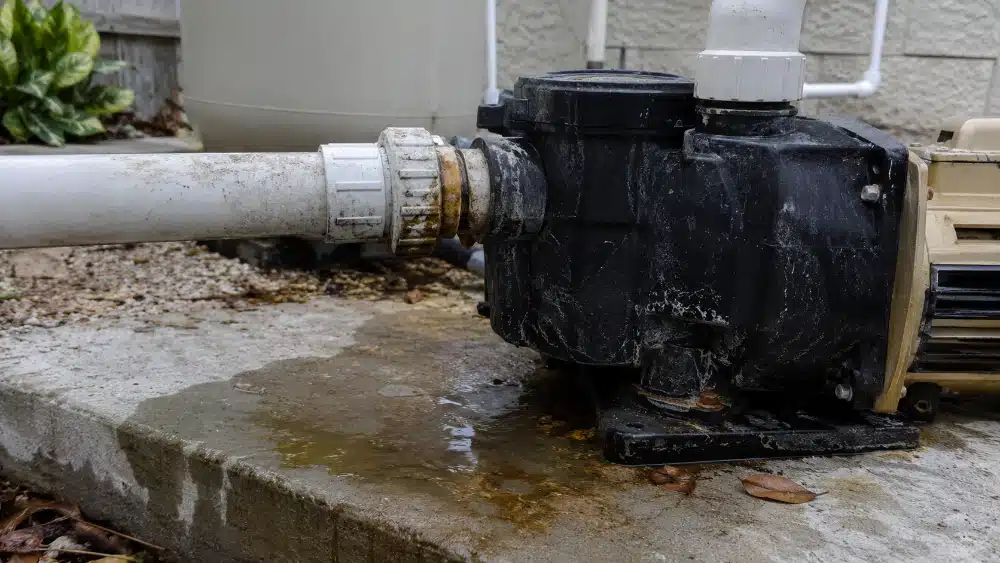
| A wet spot near the equipment pad | Almost always a failed union, valve body, or pump seal that’s fully accessible without touching the deck, a straightforward pool equipment pad repair. |
| Consistent water loss beyond evaporation | A drop exceeding roughly 2-3 cm per week points to a pool plumbing leak rather than normal splash-out or evaporation. A pressure test confirms it. |
| A buried line failure under decking or concrete | This is where pool pipe repair requires precise locating first, so excavation is limited to exactly what the repair needs, not the whole run. |