
Plumbing Leak Repair Services | No Callbacks
Across the Lower Mainland, Main Drain Mechanical works with homeowners, strata property managers, and general contractors as a Red Seal plumbing and mechanical company. Plumbing leak repair is a big part of that work, the team finds where the water is actually escaping, fixes it the right way, and leaves you a record of what was done so nothing about the invoice comes as a surprise. Every job has a Red Seal plumber on it, which means the right credentials and the right tools to stop a leak at its source rather than just buy it some time. When water is getting somewhere it shouldn’t in your home or building, this is the crew to call.
When a Leak Doesn’t Announce Itself Until the Damage Is Done
You notice a soft ceiling stain one morning, or a cabinet under the sink that smells faintly wrong. It’s easy to tell yourself it’s minor, maybe condensation, maybe a one-time drip. But a leak that’s quiet enough to ignore is often the kind that’s been running long enough to saturate drywall, soak subfloor, or work its way toward a neighbouring suite. By the time the stain gets dark or the smell gets obvious, the water has already gone somewhere it shouldn’t. And tightening the visible fitting rarely addresses where it actually started.
The Solution? Plumbing Leak Repair Services
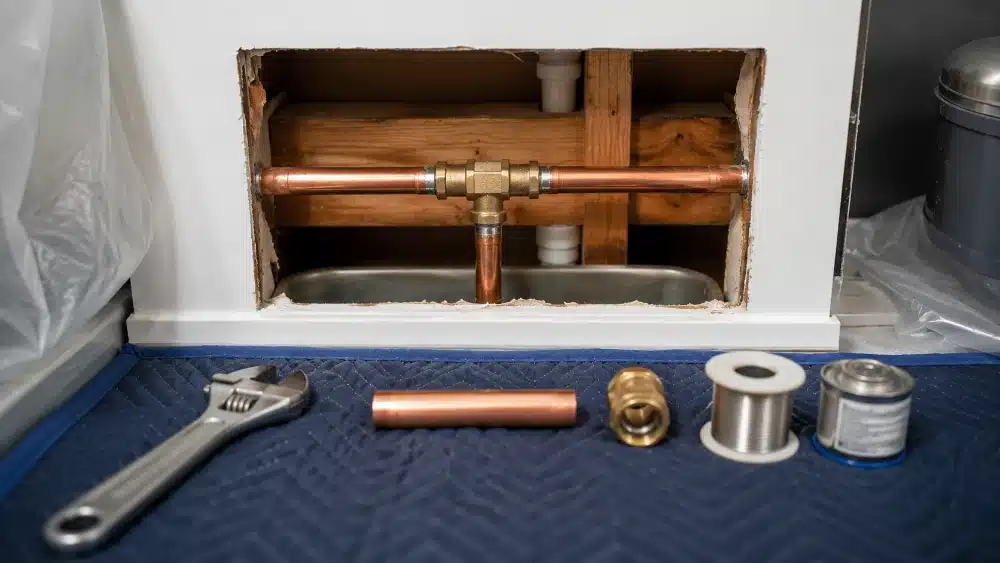
Plumbing leak repair means finding where water is escaping the system, a joint, a section of pipe, a fitting that’s corroded or shifted, and restoring it so the line holds properly under normal pressure. Main Drain Mechanical’s Red Seal plumber handles this work end to end: diagnosing the source before touching anything, accessing the pipe with minimal disruption to the surrounding space, making the repair with the right materials for that pipe type and condition, and pressure-testing the line before calling it done. Because the work is done by a licensed, insured, WorkSafeBC-covered crew, every repair is backed by a 1-year workmanship warranty.
How We Approach a Leak Repair
Every job follows the same standards, assess first, then act:
- We confirm the source before we open anything, because a stain on the ceiling or a wet cabinet floor often points one direction while the actual breach is somewhere else, finding the right spot the first time keeps the scope contained and avoids unnecessary damage.
- We check the condition of the surrounding pipe, not just the failure point, so a corroded section two feet away doesn’t become the next call, this is where a lot of callbacks start, and we’d rather catch it now.
- We use materials suited to the existing system — copper, PEX, ABS, or the applicable fitting standard — so the repair integrates properly and doesn’t create a pressure mismatch at the joint.
- We work with the minimum necessary access, protecting floors, walls, and cabinetry during the job so the space doesn’t need a separate restoration before it’s usable again.
- We pressure-test the repaired line before we leave, because a repair that holds on the bench but fails under live pressure is not a finished repair — confirming the line holds is part of the job, not optional.
- We walk you through what was found and what was fixed, in plain language, so a homeowner knows what happened in their home and a strata manager or GC has what they need to close it out or brief council.
Our Approach
How Does Our Leak Repair Works!
From the moment you reach out to the moment the job is signed off, here is what you can expect; no surprises, no vague “we’ll figure it out when we get there.”
- You describe what you’re seeing, we confirm the right approach before we arrive: Tell us where the leak is, how long it’s been happening, and what you’ve already noticed, staining, smell, sound of running water, or a spike on the water bill. That information shapes what tools and materials we bring, so we’re not making two trips where one will do.
- We trace the leak to its actual source, not just the wet spot: Water travels before it settles, so the stain on your ceiling or the damp cabinet floor rarely marks where the problem started. Our water leak detection and repair work back from the visible damage to find the origin point, whether that’s a failing supply line, a joint that’s let go behind the wall, a fitting under the slab, or a slow weep at a corroded connection.
- We walk you through exactly what we found and what fixing it involves: Before anything is opened up or replaced, you get a plain-language explanation of what’s leaking, why it’s leaking, and what the repair requires, including whether accessing the pipe means cutting drywall, opening a cabinet wall, or working in the crawl space. No scope surprises mid-job.
- The repair is made, tested, and documented: We fix the source, re-piping the failed section, replacing the fitting, reseating the supply line, or addressing the joint, then test the system under normal operating pressure before we call it done. Photos of the completed work are kept on file; for strata and commercial properties, a written service report is available for council approval or building records.
- The site is left clean and the warranty clock starts: Everything we opened to access the repair gets cleaned up before we leave. The work is covered by a 1-year workmanship warranty, so if anything related to that repair gives you trouble within the year, we come back and sort it out.
How Much Plumbing Leak Repair Costs in the Lower Mainland?
Plumbing leak repair pricing starts with a service call of $260 + GST, which covers the diagnostic visit and any minor repairs done on the same trip.
More involved plumbing water leak repair; where the source needs wall or floor access, significant re-piping, or multiple failed connections, typically runs $450–$1,500+ + GST depending on scope. Larger projects are quoted at a fixed scope after an on-site assessment, so you know the number before work begins.
The biggest factor in the final cost is how far the water travelled before it was caught, a leak found early at an accessible fitting is a straightforward fix, while one that’s saturated a wall cavity or reached a neighbouring suite takes more labour and material to put right.