
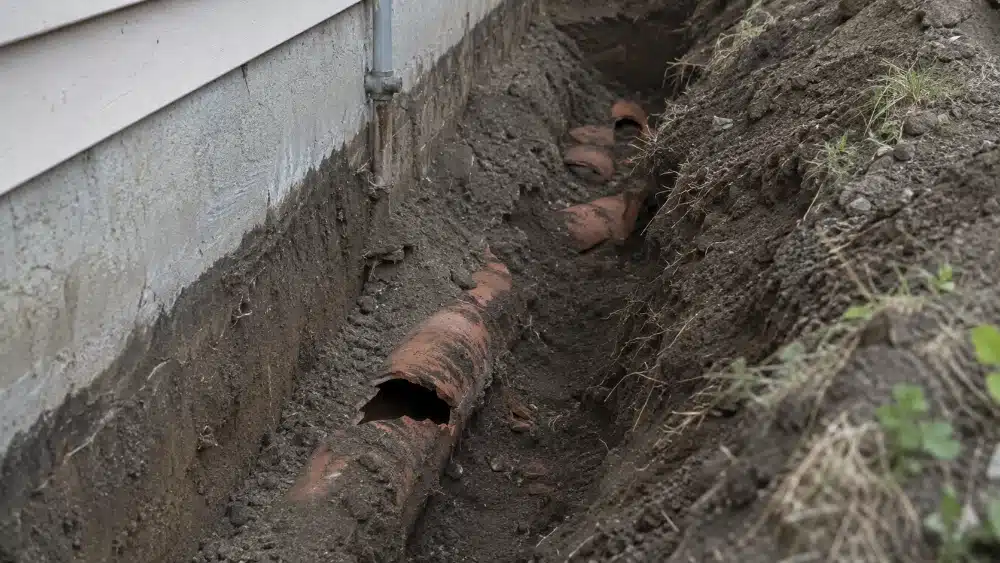
Draintile Replacement by a Red Seal Certified Plumber
Older housing stock across the Lower Mainland is reaching the point where original drain tile systems simply can’t manage what’s being asked of them, and drain tile replacement services are regular work for Main Drain Mechanical’s Red Seal certified, Class B gas fitter licensed crew, fully insured and WorkSafeBC covered on every job. If water is finding its way into your basement, your foundation soil stays wet long after it should have drained, or a camera inspection has confirmed the tile is collapsed or crushed, that’s exactly the situation this crew is built for.
When a Fifty-Year-Old System Quietly Stops Working
The water doesn’t come in all at once. It seeps, slowly, over months or years along the foundation wall, into a crawl space, or up through a concrete floor that was bone dry for decades, the kind of basement water intrusion that gets blamed on everything except its actual cause. By the time a homeowner notices a musty smell, efflorescence on the block, or a wet corner that reappears after every heavy rain, the drain tile surrounding the foundation has likely been failing for a while. Cleaning the drains or running a snake won’t change that. The pipe itself, old clay tile, concrete, or corrugated plastic that has collapsed, root-intruded, or simply crumbled is the problem, and patching around it only delays the reckoning.
Main Drain Mechanical Drain Tile Replacement
Draintile replacement means removing the failed perimeter drain system around a foundation and handling the drain tile installation of new pipe, aggregate, and filter fabric so groundwater is directed away from the structure again. Main Drain Mechanical carries out this drain tile system work as a Red Seal certified plumbing crew, which matters here because the scope crosses excavation, drain configuration, and code-compliant backfill, details that a general contractor or landscaper without trade credentials can get wrong in ways that aren’t visible until water is already in the building. The outcome of a properly executed draintile replacement is a dry, waterproofed foundation, a documented installation, and a 1-year workmanship warranty covering the work.
How We Define Quality in Our Replacements
Whether it’s a service call or a larger repair scope, the process is the same: assess it properly, explain it plainly, fix it right.
- A partial fix isn’t a fix. Replacing one failing section while leaving the rest of the perimeter untouched just delays a second excavation, so the whole run gets evaluated before any scope is set, not just the section that’s visibly failing.
- The failure mode decides the spec, not the age of the pipe. Root intrusion in the drain pipe, collapse, and joint separation each call for a different pipe rating and bedding approach – assuming “it’s old, replace it the same way” skips the one detail that determines whether the new system actually lasts.
- Undersized aggregate and skipped filter fabric are how a new system fails the same way the old one did. Neither gets substituted for something cheaper or faster, because fine soil migrating into the system restarts the exact failure this job is meant to solve.
- Working next to a footing is not routine excavation. It gets treated with the shoring and sequencing that prevent settlement or undermining during the foundation excavation, because a foundation doesn’t give a second warning before something goes wrong.
- The outlet has to actually work, not just exist. A discharge point with the wrong slope or a poor tie-in backs up under load, so that gets confirmed as part of the plan – not assumed because a pipe is technically connected to something.
- The job isn’t finished at “the water’s gone.” It’s finished when the site is restored properly enough that nothing about the yard or the foundation looks like work happened there at all.
Why It’s Worth Doing
How It Works: From Your First Call to a Warranted Job!
Most homeowners and property managers have never watched a job like this unfold before. Here’s what it actually looks like from your side, start to finish.
- Site walkthrough and scope confirmation. We walk the perimeter with you, confirm exactly which sections of the drain tile system are being replaced, and lock down where the outlet ties in. For strata properties, photo documentation starts here, before ground is broken.
- Excavation to the footing. The trench opens along the foundation wall, typically down to footing level so the new pipe intercepts groundwater before it reaches the structure – this footing drain replacement work is deliberate and careful by design, not a stage to rush.
- Old pipe removal and failure documentation. Once the drain tile is exposed, failed sections come out and we photograph what caused the failure – root intrusion, joint separation, or collapse. That record confirms the diagnosis and gives you something concrete for strata budget reports or insurance.
- New pipe, aggregate, and filter fabric installation. Perforated pipe goes in at the correct slope, bedded in clean aggregate and wrapped in filter fabric to keep fine soil out. Skipping the fabric or undersizing the aggregate is one of the most common ways a new system fails again within a few years – this step doesn’t get shortened.
- Backfill and grade restoration. The trench backfills in compacted lifts so the soil settles properly instead of subsiding next season, and the grade is restored to drain away from the foundation. The site is left clean – tools cleared, debris gone.
How Much Drain tile Replacement Costs in the Lower Mainland!
A camera inspection runs $225–$400, credited toward the repair if you proceed, it confirms whether the tile is actually failed before any excavation is quoted.
A standard residential replacement typically falls between $9,500 and $16,000, driven mostly by linear footage, three sides costs more than one. Strata and commercial perimeters are quoted individually.
Every quote is fixed-scope, confirmed after a site walkthrough, soil, depth, and access vary too much to estimate over the phone.