
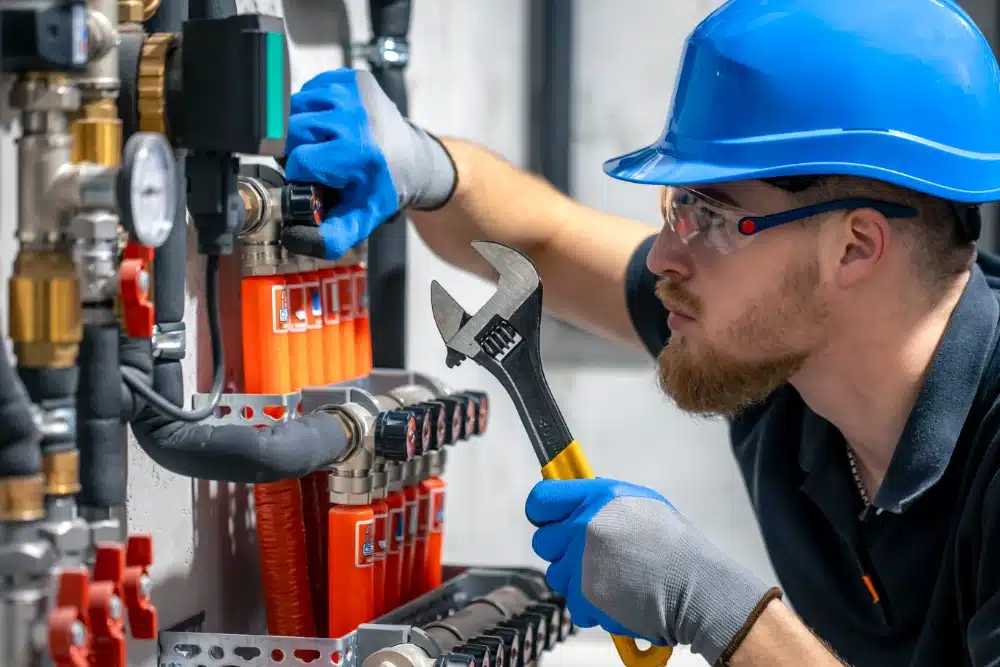
Mechanical Contractor Services for Strata Buildings, Job Sites, and Homes
Main Drain Mechanical is a licensed mechanical contractor and mechanical systems contractor serving strata property managers, general contractors, and homeowners across the Lower Mainland. With Red Seal plumber and Class B gas fitter credentials, the company sits in a specific part of the trade: complex, multi-system mechanical work that requires the right licensing and someone personally accountable on every job. If you’re coordinating vendors for a strata building or trying to find a single credentialled sub who can handle the mechanical scope without constant follow-up, that’s exactly what this crew is built for.
When One Crew Handles Everything and Something Still Falls Through
A building’s mechanical systems can run quietly for years, and the first sign of trouble is rarely the problem itself. It’s the condensate line that’s been saturating the neutralizer for months before the heat goes out at midnight. It’s the boiler that passed its last inspection but hasn’t had a proper service call since. It’s the pressure complaint that gets logged as a tenant nuisance until a suite floods. By the time the call goes out, the situation has already moved past a simple repair, and whoever shows up needs to understand the whole system, not just the one part that failed. That’s where a generalist patch job falls short, and where a fragmented vendor list, the exact vendor consolidation problem a mechanical services provider is meant to solve, makes everything harder.
What a Mechanical Contractor Actually Covers on a Job Like Yours
A mechanical contractor exists for exactly this; someone who reads the whole system, not just the part that finally failed. Main Drain Mechanical handles the plumbing, HVAC, gas, and mechanical room work that shows up together on real properties, under one licensed crew instead of three separate vendors chasing three separate symptoms. Sam and his partner hold Red Seal plumber and Class B gas fitter credentials, bringing that same whole-system accountability to residential, strata, and commercial mechanical services alike. The result: one point of contact who catches the condensate line before it saturates the neutralizer, who traces the pressure complaint back to its actual source, and who backs the work with a 1-year workmanship warranty.
How We Approach Each Drainage Service Call
Every call starts with a diagnosis, not an assumption, because the visible symptom and the actual problem are rarely the same thing.
- Credentials don’t get chased down after the fact. Liability insurance, WorkSafeBC coverage, and Red Seal and Class B gas fitter certifications are ready to hand over before the first site visit, so vendor approval never stalls on paperwork.
- A symptom doesn’t get treated as the diagnosis. A pressure complaint tied to a partially closed valve and one tied to a failing pressure reducing valve look identical from the tenant’s side, but they’re not the same repair – and confusing them is how one visit turns into a callback.
- Materials get matched to the system, not pulled from whatever’s on the truck. Older strata buildings and newer tenant improvement scopes have different requirements, and cutting corners on compatibility is how a repair becomes a bigger repair.
- A verbal summary never stands in for a written one. Every job gets documented with photos of what was found and done, because a property manager needs something to present to council, not something to reconstruct from memory.
- The space gets left the way it was found. Mechanical rooms, suites, and commercial spaces all stay tidy on the way out, because the crew’s reputation rides on what the space looks like after they’re gone.
- A warranty is only real if someone answers the phone. The 1-year workmanship warranty holds because the crew follows up when a client calls back within that period – not because the paperwork says so.
Our Process
What’s Included in a Drainage Service Call
From a single mechanical room inspection to a full preventive maintenance program, this is the building-systems scope that sits apart from a standard plumbing, heating, or HVAC call.
- Boiler inspection, servicing, and repair: the mechanical-room side of boiler work, distinct from a standalone heating call.
- Condensate system servicing: catching a saturating neutralizer before it becomes a midnight no-heat call.
- Make-up air (MUA) unit inspections: the ventilation equipment strata buildings and commercial spaces depend on and rarely think about.
- Exhaust fan and ventilation inspections: airflow systems checked as part of the whole mechanical picture, not in isolation.
- Mechanical room inspections and preventive maintenance: scheduled visits that catch what a reactive call always misses.
- Backflow testing coordination: the cross-connection safety check strata councils and municipalities require.
- Water pressure testing: confirming the building’s pressure is what the system was actually designed for, not just what it happens to be running at.
- Pressure reducing valve (PRV) repair and replacement: the component most often blamed for a symptom it didn’t cause.
What Mechanical Contractor Services Cost in the Lower Mailand?
Pricing for mechanical contractor work in the Lower Mainland depends on the scope, the systems involved, and whether the job is a single service call or a multi-visit engagement. A standard service call; including diagnostic time and minor repairs on site, starts at $260 + GST. Diagnostic and repair work that involves multiple systems, access constraints, or replacement parts typically runs in the $450-$1,500+ range.
Larger capital scopes are quoted individually and vary by project type: mechanical room upgrades typically run $10,000-$100,000+, and water line and drainage repipe projects typically run $10,000-$40,000+, both depending on the building’s age, system complexity, and material requirements. Preventive maintenance programs for strata buildings and commercial facilities are structured as annual contracts ranging from $5,000 to $50,000+ per year, customized to the building’s specific maintenance schedule. Jobs with material costs or deposit requirements over $20,000 follow the same structured payment approach applied across all Main Drain Mechanical projects.
The single biggest factor in what a job costs is how much of the system needs to be opened up, a repair isolated to one component prices very differently than one that requires tracing a problem across connected systems or working in a tight mechanical room with limited access.